Ready to Book an Appointment?
Our team is here to help you with all your dental and medical needs.
For general information only — not a substitute for professional advice. In an emergency call 999, visit A&E, or call NHS 111.
Our team is here to help you with all your dental and medical needs.
For general information only — not a substitute for professional advice. In an emergency call 999, visit A&E, or call NHS 111.
When researching tooth replacement options, you may come across both standard dental implants and mini implants. While both are designed to replace missing teeth, they differ in size, design, clinical application, and the range of situations in which they are used. Understanding the difference between mini implants and dental implants can help you have a more informed conversation with your dentist. When comparing dental implants vs mini implants, it is important to recognise that neither is universally superior \u2014 the most appropriate option depends on your individual anatomy, bone quality, and treatment goals, as determined by a professional assessment.
The primary difference is size. Standard dental implants are typically 3.5 to 5 mm in diameter and use a two-piece design, while mini implants are narrower \u2014 generally under 3 mm \u2014 and are usually a single-piece construction. This difference in dimensions affects their clinical applications, load-bearing capacity, and the range of restorations they can support.
These structural differences mean that each type is suited to different clinical scenarios. The choice between them is made based on individual assessment rather than personal preference alone.
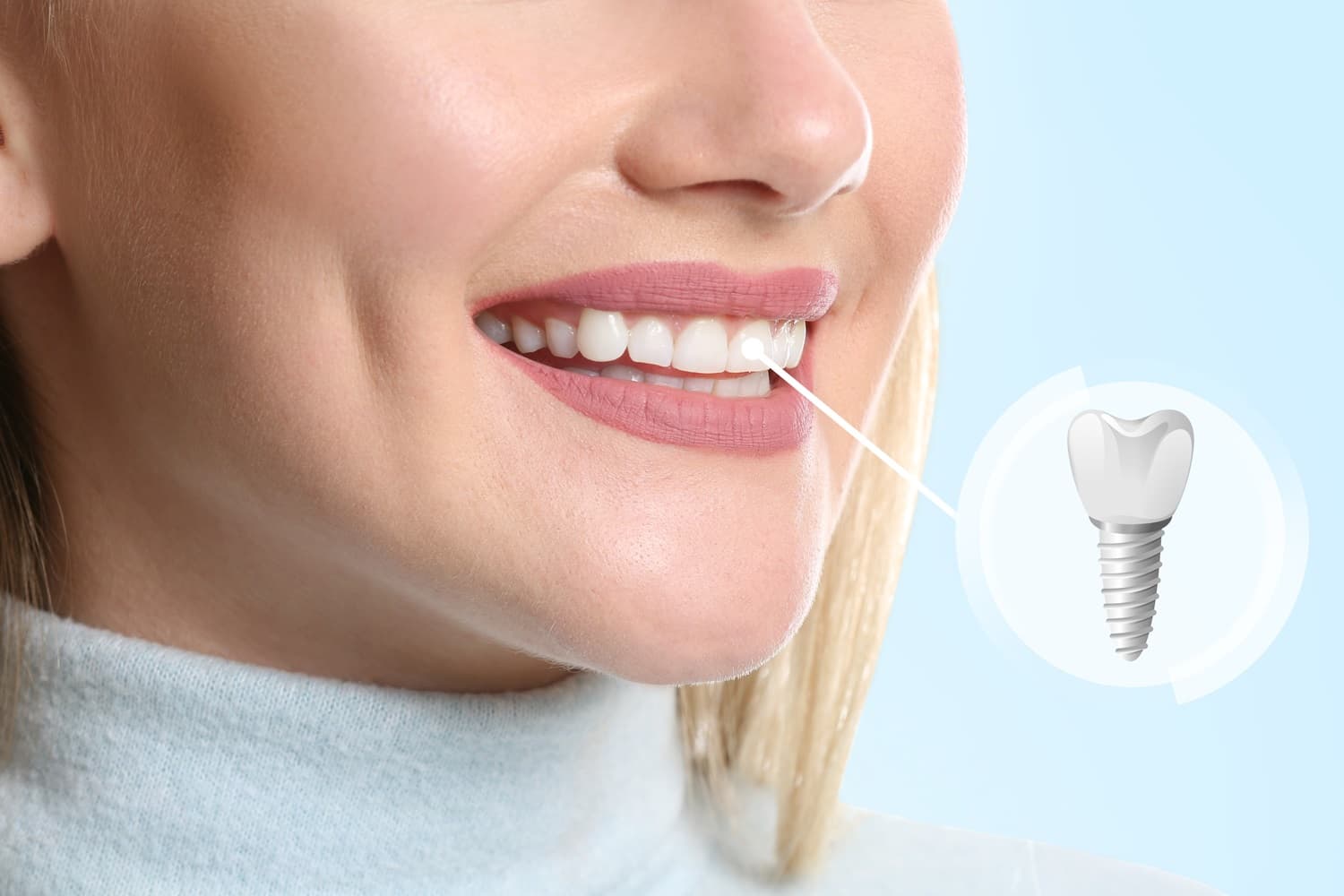
A standard dental implant is a titanium fixture that is surgically placed into the jawbone to replace the root of a missing tooth. Over a period of several months, the implant integrates with the surrounding bone through osseointegration, creating a stable foundation for a crown, bridge, or denture.
Standard implants have been used in clinical practice for over four decades and are supported by an extensive body of research. Their two-piece design allows the dentist to position the abutment and restoration independently of the fixture, offering flexibility in achieving optimal aesthetics and function. Learn more about dental implants in London.
A mini dental implant is a narrower-diameter implant, typically under 3 mm wide, that is manufactured as a single piece. It was originally developed for specific clinical situations where a standard-diameter implant may not be suitable, and it is most commonly associated with stabilising lower removable dentures.
Mini implants are not offered by all practices, and their availability depends on the clinical philosophy and experience of the treating dentist. Case selection is important \u2014 mini implants are suited to specific situations rather than being a universal alternative to standard implants.
The diameter and design of an implant directly influence how it distributes biting forces to the surrounding bone. A wider implant provides a greater surface area of bone-to-implant contact, which is generally associated with improved load distribution under functional forces.
In areas of the mouth that experience higher biting forces \u2014 such as the back teeth \u2014 a wider implant with greater bone contact may be more appropriate. In situations where the implant is primarily providing retention for a removable denture, the forces involved are different, and a narrower implant may be adequate. Your dentist will assess these biomechanical factors as part of the treatment planning process.
Both standard and mini implants can be used to stabilise removable dentures, but they do so in different ways. Standard implants are commonly used for implant-retained dentures with precision attachments, while mini implants are sometimes used specifically for lower denture stabilisation.
For patients who find their lower denture moves during eating or speaking, implant stabilisation can make a significant difference to comfort and confidence. Your dentist can assess your bone levels and discuss whether standard implants, mini implants, or an alternative approach would be most appropriate. Learn more about denture treatment in London.
Standard dental implants are supported by over 40 years of clinical research and long-term follow-up studies. Mini implants have a growing but more limited evidence base, with shorter follow-up periods in the available literature.
The depth of evidence does not mean that mini implants are ineffective \u2014 it means that their long-term performance is less well documented at this stage. When making treatment decisions, your dentist will consider the available evidence alongside your individual clinical situation. Both options have their place in modern implant dentistry.
Mini implants are often described as less invasive because the placement procedure may involve a smaller drilling protocol and, in some cases, a shorter surgical appointment. However, the term \u201cless invasive\u201d should be understood in context \u2014 it does not mean the procedure is risk-free or that clinical assessment is unnecessary.
A less invasive surgical approach can be appealing, particularly for patients who are anxious about dental surgery or who have medical considerations that favour a shorter procedure. However, the decision should always be based on what is clinically appropriate for your situation rather than a preference for a simpler procedure. Your dentist will explain the surgical approach and what to expect in detail.
The cost of implant treatment varies depending on the type of implant, the complexity of the case, and the restoration required. Mini implants may have a lower initial cost than standard implants, but the overall value depends on longevity, maintenance needs, and the range of restorations they can support.
When evaluating cost, it is helpful to consider the total investment over the lifetime of the restoration rather than the upfront price alone. Your dentist can provide a detailed written treatment plan that outlines the costs associated with each option, allowing you to make a well-informed financial decision.
If neither standard nor mini implants are suitable for your situation, or if you prefer a non-surgical approach, there are effective alternative treatments available. Your dentist can discuss these options and help you find a solution that meets your functional and aesthetic needs.
Every patient\u2019s situation is unique, and the best treatment is the one that aligns with your anatomy, health, preferences, and goals. Your dentist will present all relevant options and support you in making a decision you feel confident about. Learn more about restorative dentistry options.
The decision between standard dental implants and mini implants should be made following a comprehensive clinical examination. Your dentist will assess all relevant factors and present the options clearly, allowing you to choose the approach that best suits your needs.
Whether you are exploring implants for the first time or have been advised to consider mini implants as an alternative, the consultation is your opportunity to understand the differences in detail and make an informed decision with professional guidance. There is never any obligation to proceed.
Mini implants have a narrower diameter and a smaller bone contact surface than standard implants, which means they distribute biting forces differently. Standard implants are generally considered more suitable for situations involving higher functional loads. The appropriate choice depends on clinical assessment, bone quality, and the intended restoration.
Mini implants are not commonly used to replace individual teeth in the same way as standard implants. Their primary application tends to be denture stabilisation rather than supporting independent crowns. Your dentist can assess whether a mini implant, standard implant, or alternative restoration is most appropriate for your case.
The long-term evidence for standard implants is more extensive, with studies spanning several decades. Mini implant research is growing but covers shorter follow-up periods. Longevity for both types depends on oral hygiene, bone quality, bite forces, and ongoing professional maintenance. No implant type carries a guaranteed lifespan.
Mini implants may be considered in some cases of reduced bone volume because their narrower diameter requires less bone width. However, adequate bone quality and height are still necessary. A clinical and radiographic assessment is required to determine whether mini implants or an alternative approach is appropriate.
In some cases, mini implants can be replaced with standard implants at a later stage, provided there is adequate bone volume and overall health supports the procedure. This would require a new clinical assessment, and bone grafting may be needed. Your dentist can advise on the feasibility based on your individual circumstances.