Ready to Book an Appointment?
Our team is here to help you with all your dental and medical needs.
For general information only — not a substitute for professional advice. In an emergency call 999, visit A&E, or call NHS 111.

Our team is here to help you with all your dental and medical needs.
For general information only — not a substitute for professional advice. In an emergency call 999, visit A&E, or call NHS 111.
When it comes to improving the appearance of your teeth, two of the most commonly discussed options are teeth bonding vs veneers. Both treatments can address concerns such as chips, gaps, discolouration, and uneven edges — but they differ in material, procedure, durability, and cost. Understanding the distinction between composite bonding and porcelain veneers is an important step in making an informed decision about your care.
This guide compares the two treatments side by side, covering how each works, what to expect, and how to determine which option may be more appropriate for your individual needs.
The key difference between teeth bonding and veneers lies in the materials used and how they are applied. Composite bonding uses a tooth-coloured resin that is shaped directly onto the tooth, usually in a single visit. Porcelain veneers are thin custom-made shells, crafted in a dental laboratory and bonded to the front of the teeth over two or more appointments.
Neither treatment is inherently superior to the other. The right choice depends on the condition of your teeth, the results you are hoping to achieve, and your personal preferences regarding cost, longevity, and maintenance.
Composite bonding is a cosmetic dental procedure in which a tooth-coloured composite resin is applied directly to the surface of the tooth. The dentist shapes and sculpts the material by hand, then hardens it with a curing light and polishes it to blend with the surrounding teeth. The treatment is usually completed in a single appointment.
Composite bonding is commonly used to repair minor chips, close small gaps, reshape uneven edges, and improve the colour of individual teeth. Learn more about composite bonding treatment in London.
Porcelain veneers are thin, custom-made shells designed to cover the front surface of the teeth. They are fabricated in a dental laboratory based on impressions or digital scans of the patient's teeth, ensuring a precise fit. Veneers are then bonded permanently to the tooth surface, providing a durable and natural-looking result.
Veneers are often chosen by patients seeking a more comprehensive change in tooth shape, size, or colour. The process typically involves at least two appointments — one for preparation and impressions, and a second for fitting the finished veneers.
The following table provides a general comparison between composite bonding and porcelain veneers. Individual outcomes may vary depending on clinical factors and the treating dentist's approach.
| Feature | Composite Bonding | Porcelain Veneers |
|---|---|---|
| Material | Composite resin | Porcelain |
| Visits Required | Often one | Usually two or more |
| Enamel Removal | Minimal | Moderate |
| Longevity | Moderate | Longer-term |
| Stain Resistance | Moderate | Higher |
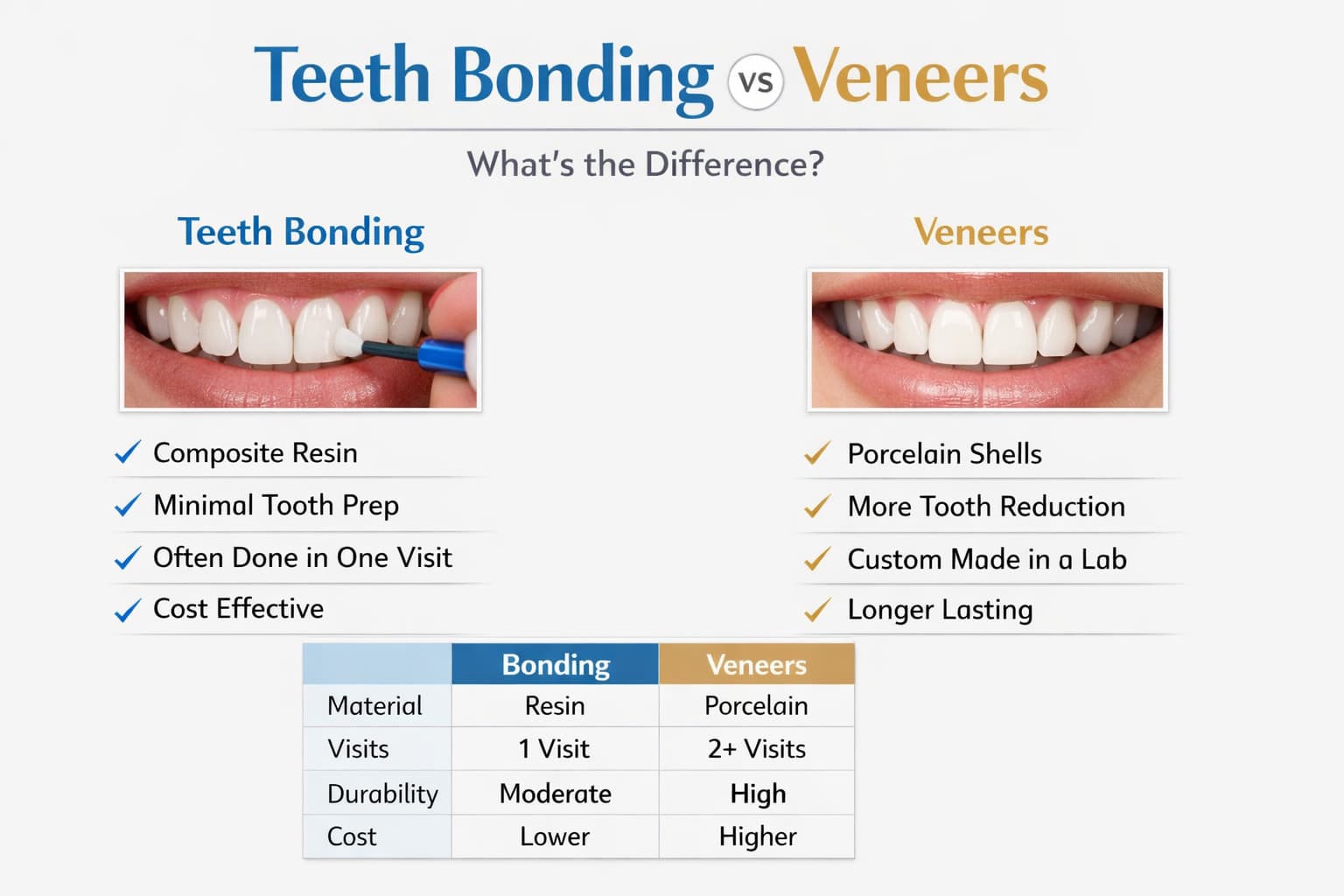
Both composite bonding and porcelain veneers can achieve a natural-looking result when carefully planned and executed. The final appearance depends on several factors, including the skill of the treating dentist, the quality of shade matching, and how well the treatment is maintained over time.
Porcelain has an inherent translucency that closely mimics natural tooth enamel, which can make veneers particularly effective for patients seeking a seamless, lifelike result. However, skilled composite bonding can also produce an excellent natural appearance, particularly for minor cosmetic improvements.
This is one of the most frequently asked questions in cosmetic dentistry, and the answer is not straightforward. Neither treatment is universally superior — each has advantages and limitations that make it more or less suitable depending on the patient's individual needs, expectations, and circumstances.
The question of whether veneers or bonding is the right choice is best answered through a clinical consultation. Your dentist can assess the condition of your teeth, discuss your goals, and explain the trade-offs of each approach in a way that is specific to your situation.
The longevity of both composite bonding and porcelain veneers depends on a range of factors, including oral hygiene, dietary habits, and whether the patient has habits such as teeth grinding. Neither option is permanent, and both will require some form of care or eventual replacement over time.
Your dentist can provide an indication of expected lifespan based on your individual circumstances, but it is important to understand that all dental restorations have a finite life and require ongoing maintenance.
Cost is an important consideration for many patients when weighing up bonding or veneers. In general, composite bonding is the lower-cost option per tooth, while porcelain veneers represent a higher initial investment. However, the total cost depends on the number of teeth being treated and the complexity of the case.
It is worth considering the long-term cost of each option, not just the initial price. Your dentist can discuss this with you during your consultation to help you make an informed financial decision alongside the clinical one.
Choosing between composite bonding and veneers ultimately depends on your individual dental needs, aesthetic goals, and personal preferences. There is no one-size-fits-all answer — the right treatment is the one that is most appropriate for your specific situation, as determined through professional assessment.
The most reliable way to determine which option is right for you is to book a consultation with a cosmetic dentist. They can examine your teeth, discuss your goals in detail, and present the options that are clinically appropriate — with no obligation to proceed.
At our London clinics, cosmetic dentistry begins with a thorough consultation. We take the time to understand each patient's concerns, discuss their goals and expectations, and carry out a comprehensive clinical assessment before recommending any treatment.
Treatment planning is personalised, taking into account factors such as tooth condition, bite alignment, oral health, and lifestyle habits. Whether a patient is considering bonding, veneers, or an alternative approach, the plan is tailored to their individual needs — and maintenance is discussed as part of the process from the outset.
Our teams at South Kensington Dental Clinic and St. Paul's Dental Clinic are available to discuss cosmetic dentistry options and help you understand the difference between bonding and veneers in the context of your own dental health.
Composite bonding is generally lower in cost than porcelain veneers, as it typically requires fewer appointments and no laboratory fabrication. However, the overall investment depends on the number of teeth treated and individual treatment needs. A consultation can provide a clearer picture of costs.
Porcelain veneers are generally considered more durable and longer-lasting than composite bonding. However, the lifespan of both treatments depends on factors such as oral hygiene, dietary habits, and whether the patient grinds their teeth. Neither option is permanent and both require ongoing care.
Both composite bonding and porcelain veneers can achieve a natural-looking result when planned and placed by an experienced dentist. Porcelain tends to replicate the light-reflecting properties of natural enamel more closely, while bonding relies on the skill of the dentist in shaping and polishing.
Porcelain veneers are generally more resistant to staining and chipping than composite bonding. However, durability depends on individual factors including bite forces, oral habits, and maintenance. Both treatments benefit from routine dental care and careful use.
In many cases, patients who have had composite bonding can transition to porcelain veneers at a later stage. Because bonding typically involves minimal enamel removal, the teeth often remain suitable for veneer preparation. Your dentist can assess whether this is appropriate for your situation.