Ready to Book an Appointment?
Our team is here to help you with all your dental and medical needs.
For general information only — not a substitute for professional advice. In an emergency call 999, visit A&E, or call NHS 111.

Our team is here to help you with all your dental and medical needs.
For general information only — not a substitute for professional advice. In an emergency call 999, visit A&E, or call NHS 111.
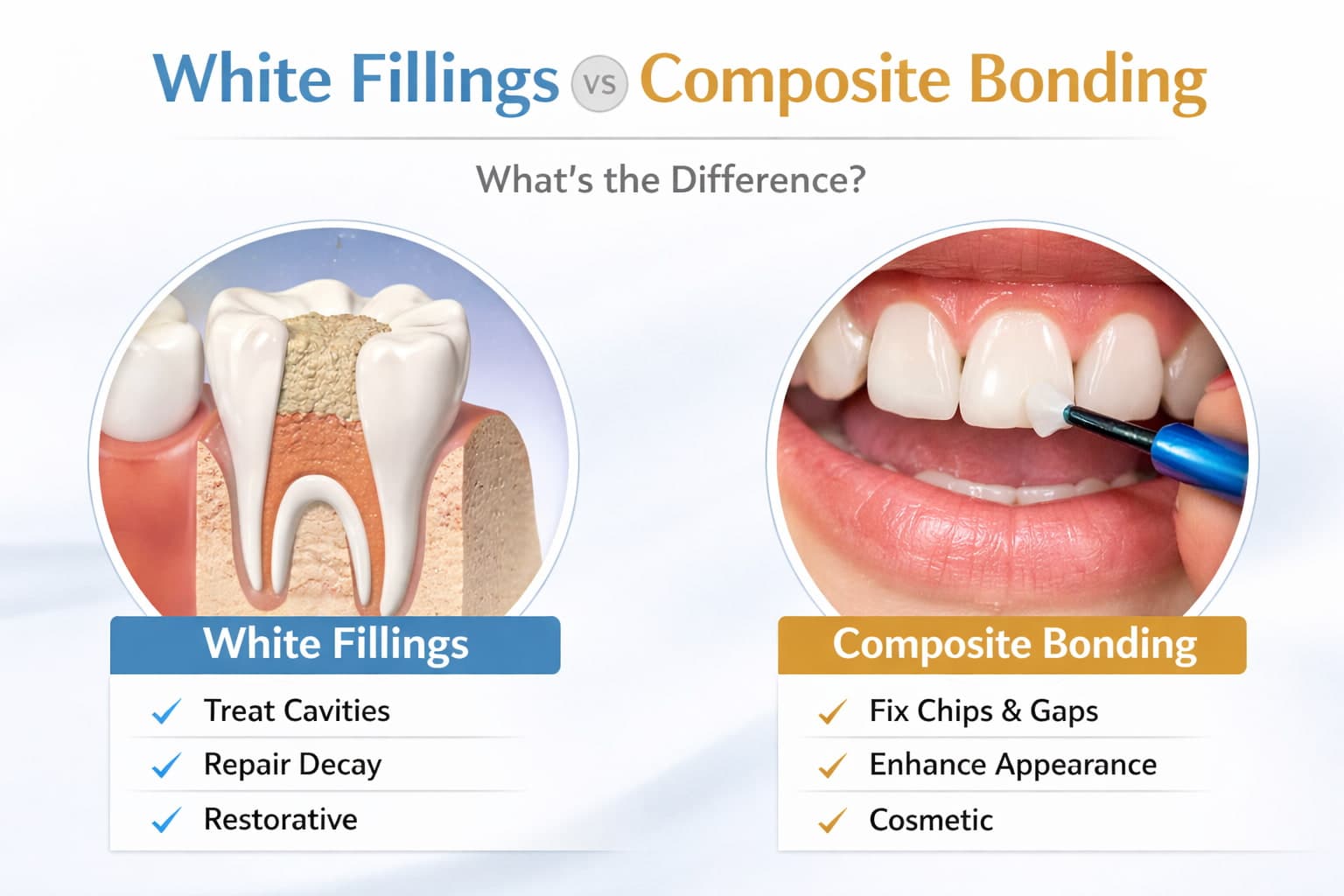
Both white fillings and composite bonding use tooth-coloured composite resin, which is one reason patients often wonder whether they are the same thing. While the material may be similar, the difference between white fillings and composite bonding lies in their purpose: one is a restorative treatment designed to repair decay, while the other is a cosmetic procedure used to improve the appearance of otherwise healthy teeth.
This guide explains how each treatment works, how they compare, and how to determine which is appropriate for your situation.
White fillings are used to treat tooth decay by removing the damaged structure and restoring the tooth with composite resin. Composite bonding is a cosmetic treatment that reshapes or refines the visible surfaces of teeth to improve their appearance. Both use similar materials, but the clinical purpose, preparation, and placement differ.
Understanding this distinction helps patients have more informed conversations with their dentist about which treatment is appropriate for their individual needs.
White fillings \u2014 also known as composite resin fillings \u2014 are a restorative dental treatment used to repair teeth that have been damaged by decay. The dentist removes the decayed portion of the tooth and fills the resulting cavity with tooth-coloured composite material, which is then shaped and hardened to restore the tooth\u2019s strength and function.
White fillings are one of the most commonly performed dental treatments in the UK. They are suitable for small to moderate cavities in most areas of the mouth. Learn more about white fillings in London.
Composite bonding is a cosmetic dental treatment in which tooth-coloured composite resin is applied to the visible surfaces of otherwise healthy teeth. The material is sculpted by hand, hardened with a curing light, and polished to blend seamlessly with the surrounding tooth structure. It is used to improve the appearance of teeth rather than to treat disease.
Composite bonding is particularly popular for front teeth where cosmetic appearance is a priority. Learn more about composite bonding treatment.
Yes \u2014 both white fillings and composite bonding use composite resin as their primary material. This is a tooth-coloured blend of glass particles and acrylic resin that can be shade-matched to the patient\u2019s natural teeth. Despite using the same type of material, the two treatments differ in their clinical application.
While the material is essentially the same, dentists may select different grades, shades, or opacities of composite resin depending on whether the treatment is restorative (filling a cavity) or cosmetic (reshaping a tooth surface). The technique, preparation, and artistic skill involved also differ between the two procedures.
The following table provides a general comparison. Individual treatment details may vary depending on clinical factors and the treating dentist\u2019s approach.
| Feature | White Fillings | Composite Bonding |
|---|---|---|
| Main Purpose | Treat decay | Improve appearance |
| Tooth Preparation | Remove decay | Minimal reshaping |
| Placement | Inside cavity | On visible surfaces |
| Cosmetic Focus | Functional + aesthetic | Primarily aesthetic |
| Appointment Length | Depends on cavity | Often one visit |
The longevity of both white fillings and composite bonding depends on several factors, including oral hygiene, dietary habits, bite forces, and the size and location of the restoration. Neither treatment is permanent, and both will require monitoring and eventual maintenance or replacement over time.
Your dentist can provide an indication of expected lifespan based on your individual circumstances, but it is important to understand that all composite restorations have a finite life. Regular check-ups allow your dentist to monitor the condition of both fillings and bonding and recommend maintenance when appropriate.
The cost of white fillings and composite bonding can vary depending on the number of teeth involved, the complexity of the treatment, and the specific clinical requirements. In general, the two may fall within similar price ranges, but several factors influence the final cost.
It is worth discussing both the initial cost and the long-term maintenance expectations with your dentist, as this can help you plan your dental care and budget accordingly.
The choice between a white filling and composite bonding is not about preference \u2014 it is determined by the clinical situation. If a tooth has decay, a filling is required. If the concern is cosmetic and the tooth is healthy, bonding may be appropriate. In some cases, a combination of both treatments may be recommended.
The most reliable way to determine which treatment you need is through a clinical examination. Your dentist will assess the condition of the teeth in question and recommend the appropriate approach based on their findings.
At our London clinics, every treatment begins with a thorough clinical examination. Whether you are attending for a routine check-up and a cavity is identified, or you are enquiring about cosmetic improvements, we take the time to explain your options clearly and help you understand the difference between restorative and cosmetic treatments.
Treatment planning is personalised, taking into account factors such as tooth condition, bite alignment, oral health, and your individual goals. Maintenance is discussed from the outset so that you have realistic expectations about how your treatment will look and feel over time.
Our teams at South Kensington Dental Clinic and St. Paul\u2019s Dental Clinic are available to discuss both white fillings and composite bonding, and to help you understand which approach is right for your dental needs.
White fillings and composite bonding both use tooth-coloured composite resin, but they serve different purposes. White fillings are restorative treatments used to repair cavities caused by decay. Composite bonding is a cosmetic procedure used to reshape or improve the appearance of otherwise healthy teeth.
Composite bonding is a cosmetic treatment and is not designed to treat cavities. If a tooth has decay, a filling is required to remove the damaged tissue and restore the tooth. Your dentist will assess the tooth and recommend the appropriate treatment based on whether the concern is restorative or cosmetic.
Neither is inherently stronger than the other, as both use composite resin. The strength and longevity of each depends on factors such as the size of the restoration, its location in the mouth, the patient\u2019s bite forces, and oral hygiene habits. Your dentist can advise on expected durability.
For front teeth with no decay, composite bonding is typically used to improve shape, close gaps, or refine edges. If a front tooth has a cavity, a white filling would be used to restore it. In some cases, a combination of both may be appropriate. Your dentist can advise on the best approach.
In many cases, old amalgam (silver) fillings can be replaced with white composite fillings. This is typically done when the existing filling is worn, damaged, or no longer providing adequate protection. Your dentist will assess the tooth to determine whether replacement is clinically appropriate.